Stockholm, October 7, 2025 — The 2025 Nobel Prize in Physics has been awarded to John Clarke (UC Berkeley), Michel H. Devoret (Yale University), and John M. Martinis (UC Santa Barbara) for their groundbreaking experiments showing how quantum mechanics can manifest in macroscopic electrical circuits.
The Royal Swedish Academy of Sciences recognized the trio “for the discovery of macroscopic quantum mechanical tunnelling and energy quantisation in electric circuits.” Their research, dating back to the 1980s, used superconducting circuits and Josephson junctions to demonstrate quantum effects in systems visible at human scales — a feat once thought impossible.
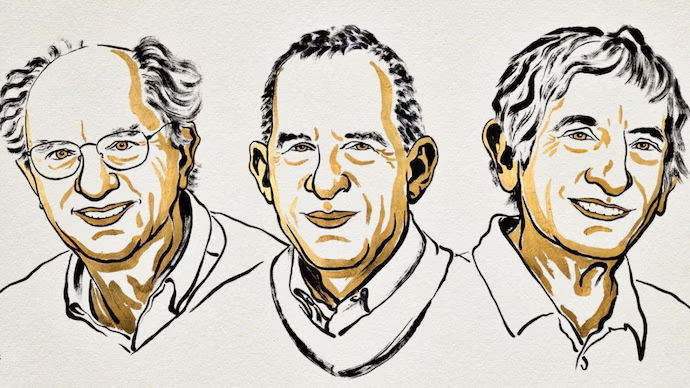
Their discoveries laid the foundation for modern quantum computing and sensing technologies, bridging theory with engineering. Clarke, who called the honor “completely unexpected,” noted that quantum principles now shape technologies we use daily.
The laureates share 11 million Swedish kronor (≈US$1.2 million) for work that has revolutionized our understanding of the boundary between classical and quantum physics. Their achievements mark a key step toward harnessing quantum behavior for practical technologies, from advanced computing to secure communication.

Context & Perspective
- The Nobel Prize in Physics is announced annually in October. This year’s announcement came on October 7 (physicists).
- The Physics prize is one of the most prestigious in the scientific world, tracing its roots back to Alfred Nobel’s will.
- Last year’s Physics Nobel went to John Hopfield and Geoffrey Hinton for breakthroughs in machine learning — exemplifying the breadth of topics that physics can encompass.
- IndiGo Flight Chaos Today: Why Flights Are Being Cancelled and What Passengers Should Know
- Meesho IPO on Fire! Early Subscription Soars as GMP Hits 40%+
- Cloudflare Outage Triggers Global Internet Blackout, Crippling X, ChatGPT, and Spotify
- Red Fort Blast in Delhi: 8 Dead, Several Injured as Explosion Rocks Historic Lal Quila Area
- ChatGPT Atlas Is Here: OpenAI’s New AI Browser That Could Replace Google Search